

FAQ

Concepts
Articles
Newsletter
🎯 Why This newsletter?
The Problem: LLMs struggle with complex, spatial, and interconnected data—leading to high training costs and brittle reasoning.
The Solution: Geometric Deep Learning and World Models solve this by mapping the world into elegant, low-dimensional mathematical structures.
The Barrier: The math is intimidating—demanding a grasp of Differential Geometry, Topology, and Group Theory.
The Newsletter: We bridge the gap, breaking down these advanced concepts into targeted, hands-on tutorials you can actually use.
Concepts
Why Geometric Deep Learning (GDL)?
Data scientists face challenges when building deep learning models that can be addressed by geometric, non-Euclidean representation of data. Those common challenges are:
High dimensionality: Models related to computer vision or images deal with high-dimensional data, such as images or videos, which can make training more difficult due to the curse of dimensionality.
Availability of quality data: The quality and quantity of training data significantly affect the model’s ability to generate realistic samples. Insufficient or biased data can lead to overfitting or poor generalization.
Underfitting or overfitting: Balancing the model’s ability to generalize well while avoiding overfitting to the training data is a critical challenge. Models that overfit may generate high-quality outputs that are too similar to the training data, lacking novelty.
Embedding physics law or geometric constraints: Incorporating domain constraints such as boundary conditions or differential equations model s very challenging for high-dimensional data.
Representation dependence: The performance of many learning algorithms is very sensitive to the choice of representation (i.e. z-normalization impact on predictors).
Reference: Presentation: Geometric World Models Beyond Tokens
What is GDL?
Geometric Deep Learning has been introduced in 2021 in the paper Geometric DeepLearning Grids, Groups, Graphs, Geodesics, and Gauges – M Bronstein, J. Bruna, T. Cohen, P. Veličković, 2021
Geometric Deep Learning (GDL) empowers data scientists to understand the underlying shape and structure of data. The objective is to learn pre-defined regularities arising from the underlying low-dimensionality and structure of the physical world … and incorporate prior physical knowledge into neural architectures.
All about Symmetry?
Yet, the topic can feel overwhelming unless approached through the unifying concept of symmetry. The concept of symmetry is central to Geometric Deep Learning. Symmetry is the organizing principle behind geometric deep learning. It tells you what should not change (invariance) or how things should change (equivariance) when you transform the input.
Is learning GDL challenging?
The steepest mountain to climb in geometric deep learning (GDL) isn’t the code or the network architectures themselves—it’s shifting from traditional Euclidean vector spaces to non-Euclidean spaces, and mastering the heavy coordinate-free mathematics required to make that shift rigorous.
Therefore, you have to become comfortable with fields of mathematics that rarely appear in standard engineering - Differential Geometry, Graph Theory, Abstract Algebra & Group Theory & Algebraic Topology.
What are the most common GDL models
Geometric Deep Learning is umbrella for many learning algorithms derived from Differential Geometry, Topology & Graph Theory, among them
Graph Neural Networks
Convolutional Neural Networks
Simplicial Neural Networks
Symplectic Network
Spherical Neural Networks
Lie Neural Networks
Graph Autoencoder Networks
Hyperbolic Neural Network
Equivariant Convolutional Neural Networks
Hodge Neural Networks
Hamiltonian Neural Networks
…..
What are World Models?
A World Model is an AI system's internal representation of how its environment behaves. Instead of just mimicking data patterns, an agent with a world model learns an abstract, predictive map of reality. It uses this map to simulate/predict "what happens next" given a specific state and action, allowing it to reason, plan, and imagine entirely within a safe, latent sandbox before ever executing a move in the real world.
Are World Models related to Geometric Learning?
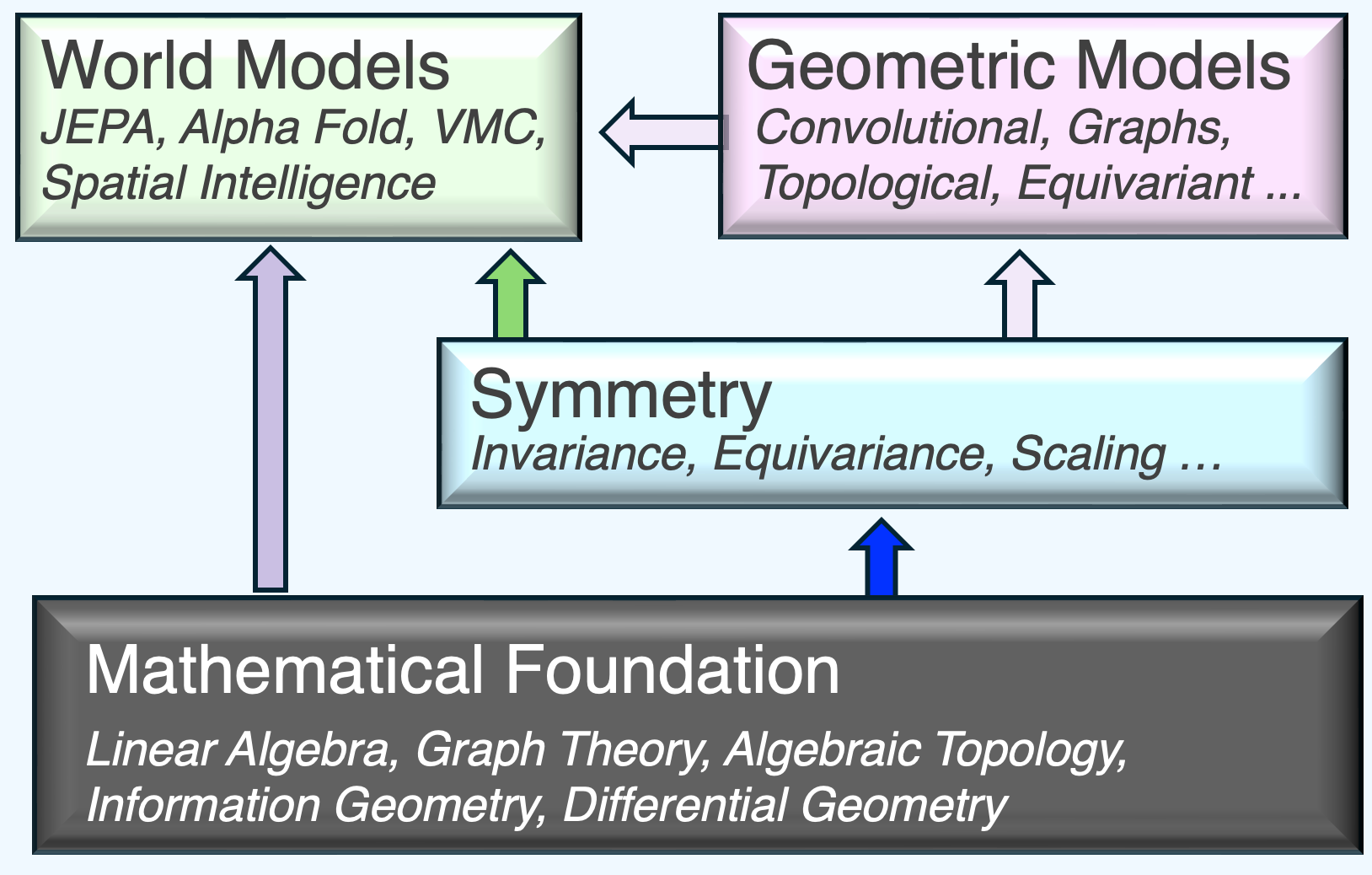
Symmetry encoders define geometric deep learning models and support reasoning tasks in World Models.
Articles Structure
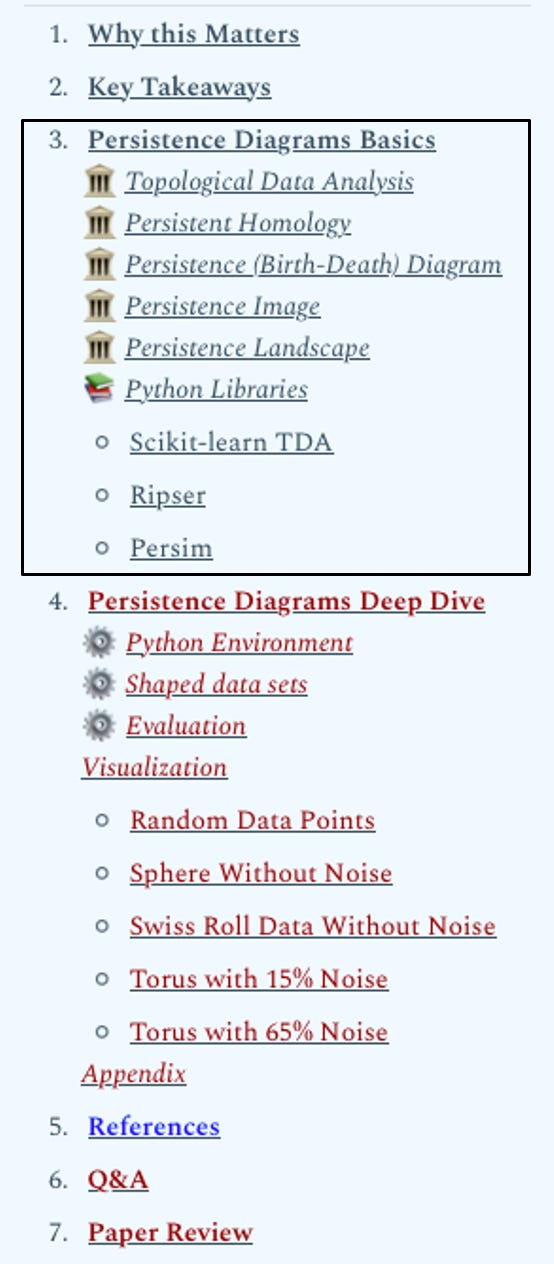
What is the Basics section?
The Basics section provides a comprehensive foundation for each topic. It describes the basic concept and the foundational knowledge, outlines the mathematical formalism, and, where applicable, and may include a basic design implementation as illustrated below.
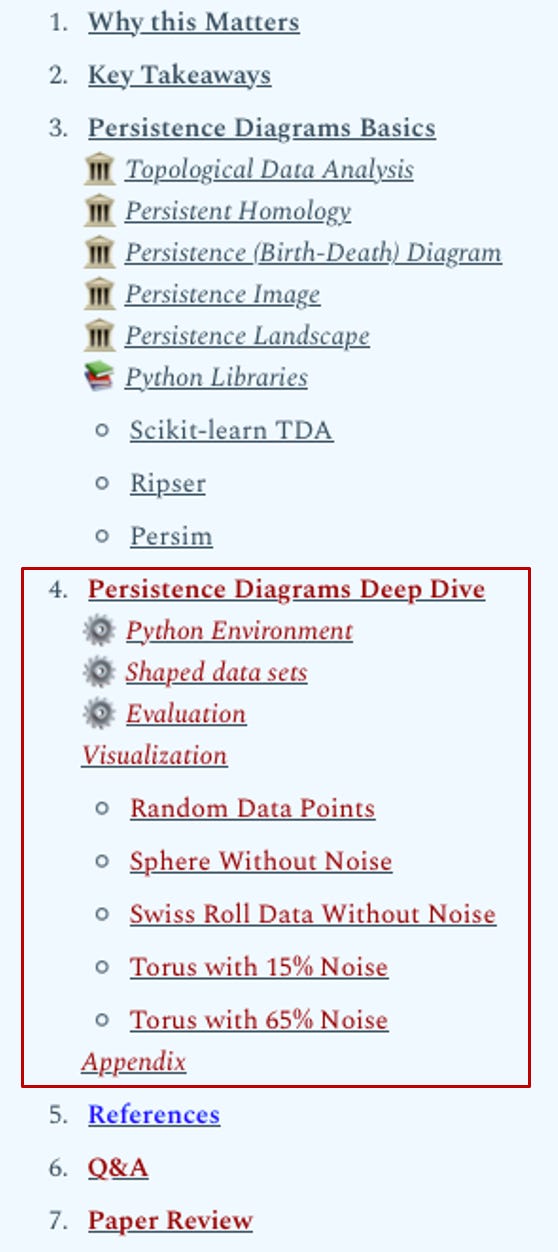
What is the Deep Dive section?
The Deep Dive section guides you through configuring your Python environment, unpacks advanced concepts, and walks through full implementation, evaluation code, test results and appendix whenever necessary as illustrated below:
Free vs. Paid Tiers
Free Tier
Includes the foundational layer of every article:
Core concepts, mathematical formalisms, and software design
Big-picture context: “Why it matters” and key takeaways
Access to the global topic/article index and master reference list
Paid Tier
Unlock the complete technical implementation:
All Free tier benefits
Advanced Deep Dive explorations
Hands-on Python code walkthroughs
Performance evaluation, benchmarks, and test results
Academic research paper and book reviews
Dedicated Q&A sections
Theory vs. Code
The icon 🏛️ theory marks sections covering the foundational knowledge of a topic, including its mathematical framework..
The icon ⚙️Code highlights sections containing Python implementations and performance evaluations of those concepts.
How can I access bibliographic References
Looking for sources? The complete reference list for all articles is always within reach. Just click the References link in the Table of Contents, or head straight to the References tab in the homepage navigation bar.
What is Q & A all about?
Think of the Deep Dive Q&A as a quick pit stop for your brain. These fun, bite-sized questions highlight essential concepts you might have scrolled past, making it easy to check your understanding. Best of all? The questions are constantly evolving based on real feedback and ideas from our readers!
What is Paper Review Section?
The Paper Review section contain an overview and analysis of a research paper or a book focused on geometric deep learning and related fields. Y
What does For Math-minded readers mean?
This is a section that describes the mathematical formalism behind the main topic of an article.
Example:

Given a latent variable z and the ith node with positional value u and feature x.
What is a note 📌?
A note contains additional useful information that is not essential to a topic.
Newsletter
Where can I find free introductory articles?
Free subscribers have full access to the comprehensive introductory articles on Geometric Deep Learning in this newsletter:
How can I access the global Reference Page?
The complete reference list for all the articles can be accessed by clicking the References tab in the homepage navigation bar.
How can I access the global Index Page?
An alphabetical list of all topics and their article links is available by clicking Index in the main navigation bar.
What is the research paper & book Reviews page?
These are concise overviews and analyses of research papers or books focused on geometric deep learning and related fields. You can access the complete collection directly via the "Reviews" link in the main navigation bar.
Python Libraries
Hands-on Geometric Deep Learning articles rely on Python language versions 3.11 and later and the following high level libraries:
Matplotlib: Although there are many sophisticated plotting Python library, Matplotlib’s flexibility and community support makes it the framework of choice to describe output of computational this newsletter - https://matplotlib.org
Numpy: The default package for numerical & scientific computation in Python - Its use in this newsletter is restricted to computations not related to machine learning problems. - https://numpy.org/
Manim: Manim is the gold standard for high-quality, explanatory math videos. It is particularly suitable for Calculus, linear algebra, and complex equations where precise “morphing” between formulas and shapes is needed - https://www.manim.community/
Scikit-learn: It is the most commonly used machine learning library. It is used sparingly in this newsletter for topics not directly linked to neural network architectures. - https://scikit-learn.org
PyTorch: PyTorch is an optimized tensor library for deep learning using GPUs and CPUs. The original open-source project branched out into multiple domains from TorchVision to Torch Geometric. - https://pytorch.org/
PyTorch Geometric (PyG): This library has emerged as a leading library for exploring and implementing a large variety of Graph Neural Networks using PyTorch - PyG Documentation
Geomstats: The core concept of Geomstats is to incorporate differential geometry principles, such as manifolds, Lie groups, into the development of machine learning models - https://geomstats.github.io/
TopoNetX: This library provides tools for constructing and performing computations on topological domains – Simplicial, Cell, Combinatorial Complexes, and Hypergraphs. It supports operations on nodes, edges, and higher-order cells - https://pyt-team.github.io/
Scikit-learn TDA: It targets non-topologists with its support of persistent homology and mapper - https://docs.scikit-tda.org
Ripser: This library is a lean persistent homology package for Python bundled within Scikit-Learn TDA - https://pypi.org/project/ripser/